
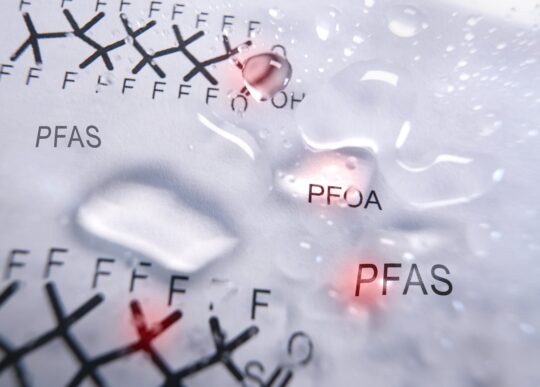
Perfluoroalkyl and polyfluoroalkyl substances (PFAS), sometimes referred to ‘forever chemicals’, are a group of synthetic chemicals that have been used around the world for decades. Their durability, combined with their heat, water, oil, and grease-resistant properties, has made them commonplace within the home and beyond, while also causing great environmental concern.
Many per- and polyfluoroalkyl substances are extremely persistent in the ecosystem, spreading through water sources and leaching into soils for long periods of time. Once contaminated, they’re difficult to remove, and for industries that require a purification solution for drinking water and wastewater, landfill leachate, or contaminated land treatment, understanding the impact of PFAS is becoming increasingly important
What are PFAS?
PFAS is the collective name for thousands of man-made compounds that include multiple ultra-strong carbon-fluorine bonds; they are incredibly robust and therefore highly resistant to chemical, thermal, and biological degradation. This level of stability gives PFAS incredibly useful properties, but results in them remaining in the environment for extended periods, rather than naturally breaking down. While there are thousands of PFAS chemicals existing, some of the most well-known ones include:
- Perfluorooctanoic acid (PFOA).
- Perfluorooctane sulfonic acid (PFOS)
- Perfluorohexane sulfonate (PFHxS)
- Perfluorononanoic acid (PFNA)
Many long-chain PFAS are now being heavily regulated or phased out in several countries, with the aim of taking a responsible and practical approach to rising environmental and public health concerns.
Where can PFAS be found?
The unique properties of PFAS have led to their use across a broad range of industrial and commercial applications. These include:
- Firefighting foams used at airports, military sites, and industrial facilities, in so-called AFFF (aqueous film-forming foam)
- Non-stick cookware coatings
- Water and stain-resistant textiles
- Food packaging designed to resist grease
- Industrial manufacturing processes
- Metal plating operations
- Electronics manufacturing
- Some cleaning products and cosmetics
Why should we be concerned about PFAS?
Most PFAS are highly stable and travels great distances through groundwater and surface water, making them difficult to contain. There are several challenges with PFAS, including
Long-term environmental presence
PFAS remains in soil and water for many years without any significant natural breakdown. This allows contamination to spread far greater than its original source.
Contamination in water
Many PFAS compounds dissolve quickly in water, allowing them to migrate through aquifers, rivers, and drinking water supplies. This eventually increases the complexity across remediation projects.
Bioaccumulation
Some PFAS chemicals can accumulate in animals and humans over time through repeated exposure, causing potentially harmful side-effects. While not every PFAS chemical shares the same characteristics, it has been well-documented that this is the case for some compounds.
Growing regulatory pressure
On a global scale, governments are introducing stricter limits against PFAS in drinking water, wastewater, and industrial discharge. As monitoring requirements evolve, environmental agencies are placing greater limits on sectors and emphasising treatment technologies and compliance.
How can PFAS be treated effectively?
PFAS contamination has been prevalent for decades, stemming from multiple sources, such as:
- Industrial wastewater discharge
- Fire training facilities using aqueous film-forming foam (AFFF)
- Landfill leachate
- Wastewater treatment plant effluent
- Biosolids applied to agricultural land
- Manufacturing facilities producing or using PFAS-containing materials
Removing PFAS has many technical challenges, with water sources being a major cause of concern. Conventional water treatment methods are typically not designed to capture these highly stable compounds, with treatment performance depending upon several additional factors that cover various concentration levels, the effluent source, and required treatment objectives.
Activated carbon
One of the most widely used treatment methods for PFAS abatement, and especially for persistent long-chain variants, is granular activated carbon (GAC). The porous structure of activated carbon can be optimised to absorb PFAS, PFOA and PFOS molecules within filtration beds, reducing concentration levels in treated water and in-situ or ex-situ soil remediation.
Activated carbon is highly favoured since it can be formulated to meet specific abatement needs and outcomes, while also having the ability to be safely reactivated at a specialist, professional facility, therefore continuing the lifecycle of PFAS treatment. Unlike standard alternatives, Puragen’s global award-winning solution operates via a comprehensive three-stage methodology
- Search: The Centre of Technical Excellence tests and characterises customer samples to detect PFAS even at trace levels.
- Capture: High-grade FiltraPure® activated carbons are engineered specifically for high-efficiency short and long-chain PFAS adsorption.
- Destroy: The REACT-Sys® / REACT-Sys+ advanced thermal reactivation process permanently destroys PFAS molecules, achieving a complete breakdown without relying on landfill or hazardous incineration.
Ion exchange resins
Ion exchange resins are commonly used where high removal efficiencies are required. Certain resin formulations have demonstrated strong performance for a wide range of PFAS compounds. Some ion exchange resins can be regenerated for re-use, but this depends on local evaluation and authorisation, together with the intended application – for example drinking or wastewater treatment. Where regeneration is not possible, the resulting spent IEX resin waste stream requires specialised disposal.
Membrane filtration
Reverse osmosis and nanofiltration systems can achieve excellent PFAS removal by physically separating contaminants from water. Although proven to be successful, they require a greater energy input and have their own waste streams that require management.
Excavation
This process is specifically for the treatment of soil, which focuses on digging up contaminated soil and being taken to a safe disposal site and is most suited for areas where contaminants remain localised.
Soil washing This involves a physical or chemical process to strip PFAS chemicals from the soil. Again, this process is quite energy intensive with additional waste output, with poor effectiveness on lower concentration levels.
What does the future look like for PFAS?
With increasing focus on the sources and environmental impact of PFAS, such as Defra’s First PFAS Plan in the UK, and also stricter legislation against PFAS, such as the EU Drinking Water Directive, it has become less about being aware of PFAS but more so how businesses can meet compliance now and into the future.
With this comes strict monitoring methods, and the risk of severe penalties for failure to comply. Sectors are therefore facing greater pressure than ever before, with global deadlines becoming established throughout 2026 and 2027. Although regulations continue to evolve, PFAS management and treatment will remain a core concern for industries, which must adhere to purification and responsible environmental protection.
Achieve effective PFAS abatement with Puragen
Managing PFAS requires understanding of both the contaminant and suitable treatment type to deliver a successful treatment plan. Activated carbon plays an important role in many PFAS filtration systems, helping industries to continually reduce contaminants in varying concentrations.
At Puragen, we help industries achieve compliance across several PFAS treatment methods and flexible mobile filters, with a focus on drinking water, industrial wastewater, groundwater, landfill leachate, process water purification, and soil remediation.
When combined with our advanced thermal reactivation process, it forms the basis of our global award-winning solution to this problem that we call “Search, Capture & Destroy”. Puragen operates as a true full-service purification partner—delivering an end-to-end, closed-loop solution that moves seamlessly from trace detection to total contaminant destruction.
Get in touch with a member of our team to further learn about our search, capture, and destroy approach to PFAS.