
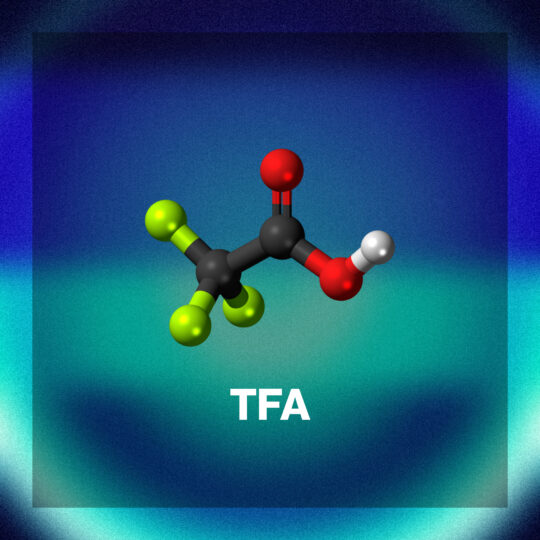
Most organisations are now familiar with PFAS — the broad family of persistent chemicals that has risen to the top of the environmental regulatory agenda. But within that family, one compound is drawing increasing attention from scientists and regulators: trifluoroacetic acid, or TFA. Smaller, more mobile and harder to treat than the PFAS compounds most operators have planned for, TFA represents the next wave of the PFAS challenge — and for many industries and countries, the regulatory clock is already ticking.
What is Trifluoroacetic Acid (TFA)?
TFA is an ultra-short-chain PFAS compound — and the smallest member of the PFAS family. Like all PFAS, it contains carbon-fluorine bonds, one of the strongest in chemistry, which makes it extraordinarily resistant to degradation. Unlike longer-chain PFAS such as PFOA , however, TFA’s tiny molecular size gives it exceptional water solubility and environmental mobility, allowing it to move rapidly through soil, groundwater and surface water with very little resistance.
TFA is not primarily manufactured as a product. It is mainly a breakdown product — a daughter compound formed when larger PFAS molecules degrade. It is estimated that around 2,000 different PFAS compounds can ultimately break down into TFA, including:
- Hydrofluorocarbons (HFCs) and hydrochlorofluorocarbons (HCFCs) used in refrigerants and propellants
- Fluorinated pesticides and agrochemicals
- Pharmaceuticals containing fluorinated compounds
- Industrial fluoropolymers and fluorochemicals
- Fire-fighting chemicals including AFFF foam
This means TFA is not confined to a single sector or source — it is a systemic product of the fluorinated chemistry that underpins vast areas of modern industry.

How Widespread is TFA Contamination?
The scale of TFA contamination is only now becoming clear, and the findings are significant. In the UK, 98% of river sites tested have been found to contain TFA. Globally, TFA has been detected in rainwater, drinking water, oceans and even glaciers — confirming that it is a near-universal environmental contaminant.
Two sources dominate:
Agricultural use of fluorinated pesticides is considered the primary source of TFA contamination in rural water environments across Europe. At least 30 PFAS-containing active substances are currently approved for use in pesticides in Great Britain, the majority of which have the potential to degrade into TFA through environmental breakdown processes.
Industrial activities are the dominant source in urban and industrial environments. The production of fluorinated gases (F-gases), fluoropolymers, pharmaceuticals and fire-fighting chemicals can all generate TFA or TFA precursors. F-gases are of particular concern because they produce gaseous TFA precursors that can enter the atmosphere and deposit widely through rainfall.
Wastewater treatment presents an additional challenge. Wastewater streams frequently contain TFA precursors — including pharmaceutical compounds — which can form TFA during treatment. Standard wastewater treatment processes cannot remove TFA, meaning its concentration passes largely unchanged through conventional treatment cycles and into receiving water bodies.
Why is TFA a Concern?
TFA belongs to the same PFAS subgroup as PFOA — one of the most studied and tightly regulated PFAS compounds in the world. Its ultra-short carbon chain makes it uniquely problematic for four reasons.
First, it is exceptionally persistent. TFA does not biodegrade under natural environmental conditions. Once present in soil or water, it remains indefinitely without active intervention — the definition of a ‘forever chemical’.
Second, it is highly mobile. Its small size and high water solubility mean TFA moves freely through the environment, crossing between soil, groundwater and surface water with ease. It does not bind to soil particles the way longer-chain PFAS do, making containment and source control more difficult.
Third, it is accumulating. As upstream PFAS compounds continue to degrade, and as industrial and agricultural use of fluorinated chemicals continues, the environmental burden of TFA is growing. Current evidence on direct human health effects is still developing, but phytotoxicity — harm to plant life — has been demonstrated at higher concentrations, and regulatory concern is increasing as monitoring data improves.
Finally, it has been classified as toxic. In June 2026, the European Chemicals Agency’s (ECHA) Risk Assessment Committee (RAC) announced that TFA was categorised as a Reproductive Toxicity Category 1B subtance, meaning it “may damage the unborn child and impair fertility”. This classification will only serve to increase scrutiny on this compound, and it is reasonable to asssume that other jurisdictions will follow suit with a similar categorisation.
The Regulatory Picture
TFA’s regulatory status is moving quickly, particularly in Europe.
European Union
The revised EU Water Framework Directive, Groundwater Directive and Environmental Quality Standards Directive entered into force in May 2026, bringing TFA into the list of regulated pollutants for the first time. This reflects the weight of scientific evidence on TFA’s persistence and widespread occurrence in water. TFA is also subject to the broader universal PFAS restriction under REACH, which is progressing through the European Chemicals Agency (ECHA) process and aims to restrict the manufacture, use and placing on the market of PFAS as a class.
United States
The US EPA recognises TFA as a PFAS compound, but it is not currently subject to the PFAS National Primary Drinking Water Regulation introduced in 2024, which focuses on PFOS, PFOA and a small number of other long-chain compounds. However, the EPA has signalled concern about PFAS precursors and degradation products, and regulatory coverage is widely expected to expand.
United Kingdom
The UK’s approach to PFAS regulation is evolving. The Environment Agency and DEFRA are coordinating an overarching PFAS policy framework, and existing guidance already addresses PFAS in environmental permits on a site-specific basis. Although TFA is not yet subject to specific UK regulatory limits, proposed UK REACH reforms are expected to follow the trajectory of European policy on PFAS and their precursors. For water companies and manufacturers producing or handling fluorinated compounds, TFA is an increasingly important consideration — one that prudent organisations are beginning to monitor now, ahead of formal requirements.
The Treatment Challenge: Why TFA is Harder to Remove Than Other PFAS
TFA’s ultra-short chain length — the very property that makes it so environmentally mobile — also makes it harder to treat than conventional PFAS compounds. Standard granular activated carbon (GAC), which performs well for longer-chain PFAS such as PFOS and PFOA, has significantly lower affinity for TFA and other short-chain compounds. This is a genuine technical challenge that the water treatment industry is actively working to address.
Alternative approaches exist — including ion exchange resins, nanofiltration and advanced oxidation processes — but each comes with limitations. Ion exchange can be effective but generates a concentrated waste stream that itself requires disposal. Nanofiltration membranes act as a barrier but do not destroy TFA, creating a concentrated reject stream. Advanced oxidation shows promise but remains energy-intensive and difficult to scale for large water volumes.
This raises a question that many operators and treatment professionals are grappling with: even where we can capture or concentrate TFA, what do we do with the waste? Moving contamination from one medium to another is not a solution — it is a deferral. The industry needs approaches that don’t simply relocate the problem.
Puragen’s Approach: Search, Capture & Destroy
Puragen’s award-winning Search, Capture & Destroy process is designed to address the challenge of PFAS removal and destruction. i.e. not just removing PFAS from water, but permanently destroying them so there is no secondary waste problem to manage. Our focus to date has been on longer chain PFAS compounds, notably the group identified in UK and EU drinking water guidelines such as PFAS and PFOA, but our team of technical experts are working, at speed, to develop treatment options for the far trickier TFA compound.
Search
Puragen begins by analysing your water or gas chemistry using advanced laboratory techniques including LC-MS (Liquid Chromatography-Mass Spectrometry), detecting dozens of PFAS molecules at trace concentrations. Accurate characterisation is essential before selecting the appropriate treatment pathway.
Capture
Contaminants are removed using Puragen’s FiltraPure® CH range: surface-modified granular activated carbons engineered with unique surface chemistry that delivers a significantly higher affinity for PFAS — including shorter-chain compounds — than standard activated carbon. Deployment is typically via Puragen’s AquaSorber® mobile filtration units, which can be brought directly to site without the need for permanent infrastructure.
Destroy
Rather than sending PFAS-loaded carbon to landfill or standard hazardous waste incineration, Puragen collects spent media and transports it to its specialist thermal reactivation facility in Immingham, UK. The REACT-Sys® system thermally treats the carbon at conditions designed to break down and destroy PFAS molecules, resulting in complete mineralisation. The carbon is then recovered and recycled for reuse — reducing CO₂ emissions by around 90% compared to manufacturing virgin carbon, and eliminating the secondary waste problem entirely.
This circular approach — capture, destroy, reuse — is what distinguishes Puragen’s solution from treatment methods that merely concentrate or relocate PFAS contamination.

What Could Operators Do Now?
TFA regulation is moving from the scientific literature into legislation. For operators in water utilities, industrial manufacturing, agriculture-adjacent industries and waste treatment, the time to act is before compliance deadlines arrive. Practical steps to take may include:
- Establish a baseline. Begin monitoring for TFA in your water, effluent or discharge streams. Without baseline data, you will have no way to demonstrate compliance or track trends as regulation tightens.
- Review your fluorinated chemical inventory. Identify which processes, products or raw materials on your site have the potential to generate TFA or TFA precursors, and assess the associated risk.
- Engage with regulatory developments. The EU framework is now in force. UK alignment is anticipated. Understanding where regulation is heading allows you to plan capital investment and treatment strategies ahead of time.
- Speak to a specialist. TFA treatment requires expertise in short-chain PFAS chemistry. Not all activated carbon or PFAS treatment solutions are equivalent and new developments are commercialised on a regular basis — early conversations with a specialist will help you understand your options before you are under pressure to act.
Conclusion
TFA is not a future concern — it is a present one. It is already in the water network, it is accumulating, and regulation has begun to catch up. For organisations that have invested in managing longer-chain PFAS, TFA represents the next frontier: harder to treat, more mobile, and governed by a regulatory framework that is tightening fast.
The good news is that effective, circular treatment solutions are under urgent development. The question is whether your organisation is ready to use them.
TFA is an emerging challenge — don’t wait for regulation to catch up. Talk to the Puragen team about future-proofing your PFAS monitoring and treatment strategy, or find out more about our Search, Capture & Destroy process and drinking water treatment solutions.