
Background
A landfill gas (LFG) power generation site operating three engines faced persistent issues with siloxane contamination in the fuel supply. Siloxanes and VOC present were causing severe engine wear, leading to increased downtime, operational disruption, and significant maintenance costs.
Challenge
High levels of silicon and other contaminants were entering the engines, resulting in:
- Accelerated piston and liner wear
- Heavy ash accumulation in combustion chambers, with chunks of ash breaking off and causing liner damage and premature head failures
- Oil degradation after only 168 hours of operation, forcing weekly oil changes
- Reduced generator uptime due to operational issues and unplanned maintenance
These issues significantly operational costs and threatened the long-term reliability of the generating fleet.
Solution
The customer had previously explored the financial viability of activated carbon purification but was unsure whether the benefits—reduced wear, lower maintenance, and extended oil life—would outweigh the cost of carbon, changeouts, and operational impacts.
A change in the customer’s engineering leadership brought renewed interest in activated carbon treatment. The new engineering lead had previously worked with Puragen and understood the potential advantages of upstream gas purification.
Following discussions with Puragen, a small-scale purification trial was initiated to fully evaluate system performance without long-term commitment. This proof-of-concept approach ensured: no upfront commitment to carbon volumes, no operational disruption and a data driven benefit assessment.
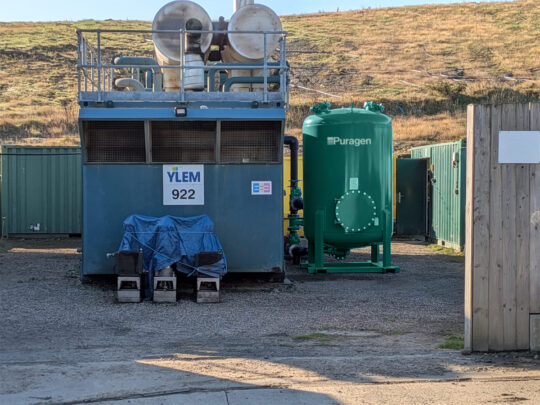
The trial, commencing September 2025, involved two VOCSorber 2-SX mobile filters, on two of the site’s LFG engines. The filters were designed to remove siloxanes and NM-VOCs from the landfill gas prior to combustion, with the primary objective of reduce siloxane loading, extended oil life, reduced component degradation.
Key elements of the trial approach included:
- Implementation of carbon filtration as a pre-cleaning stage
- Regular internal inspections every 1,000 hours to assess ash buildup and combustion chamber condition
- Monitoring oil life, silicon levels, and metal wear.
Results
- Dramatic Extension of Oil Life
- Oil life increased from 168 hours to nearly 1,000 hours—a 6x improvement.
- Oil analysis showed no signs of increased metal wear, indicating that siloxane-related abrasion had been effectively curtailed.
- Reduction in Internal Engine Wear
- Routine 1,000-hour inspections revealed significantly reduced ash buildup.
- No large ash fragments were observed breaking off into the cylinders, reducing the risk of liner damage and premature head failures.
- Lower Operational Costs & Improved Uptime
- Fewer unplanned overhauls and reduced component wear lowered operational expenses.
- Cleaner gas supply led to more stable engine performance and increased generating availability.
Based on the strong performance of the trial system, plans were developed for a permanent full-scale purification solution using a CleanFlo VOCSorber 30 m³ filter for all three engines, ensuring consistently cleaner gas across the entire generating fleet.
The permanent system is expected to drive further reductions in operational and maintenance costs and enhance long-term asset reliability, maximising uptime, minimising maintenance, and reducing total cost of ownership.