
Context
The Daikin Chemical France (DCF) site, located in Pierre-Bénite near Lyon, primarily produces a fluoroelastomer – a high-performance rubber material used in the automotive sector, as well as in other strategic industries such as aerospace, energy, and microelectronics. To ensure that its products deliver the properties required by its customers (high elasticity, resistance to heat and humidity, etc), DCF utilises fluorinated substances, including PFAS group chemicals, within its manufacturing process. To comply with local regulations and meet the emission thresholds established by authorities, DCF turned to Puragen to identify a solution capable of controlling emissions of fluorinated substances into the air.
Challenge
The challenge was twofold:
- Control the emission levels of fluorinated substances in the air, keeping them below the thresholds set by local regulations.
- Test and validate innovative filtration solutions capable of treating these fluorinated substances efficiently.
As the first installation of its kind in France for PFAS treatment in gaseous effluents, in-depth analysis was required to understand the behaviour of these molecules and continuously optimise the air effluent treatment process.
Solution
A testing phase was carried out between January and February 2024 by installing several pilot filters at the DCF site to evaluate the performance of different types of activated carbons. Puragen deployed four Clean-Flo® mobile filters for this phase, including two types of activated carbon specifically used for treating fluorinated substances.
With this initial phase proving conclusive, the project moved into an operational phase in August 2024 with the installation of four High Flow HF20V® filters across the full airflow stream, enabling the DCF site to capture more than 92% of fluorinated substance emissions into the air.
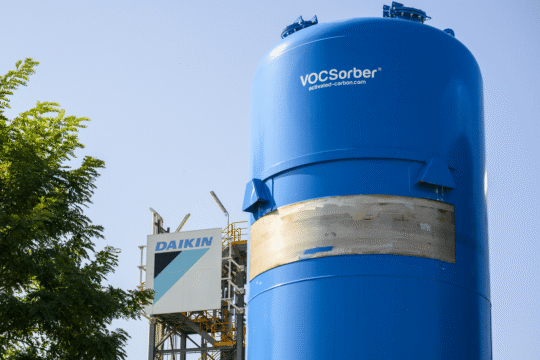
Building on these results, the system was further optimised in April 2025 with the addition of two VOCSorber® 30 filters. The increase from four to six filters was driven by the need for greater adsorption capacity, improved carbon performance, and extended carbon change-out intervals. This optimisation has enabled more efficient removal of PFAS, increasing overall capture levels and enhancing system reliability.
All spent activated carbon from this installation is sent for reactivation rather than landfill or hazardous incineration. Through the REACT-Sys® process, 100% of captured PFAS is removed. Reactivation restores the carbon’s pore structure for reuse, while thermal oxidation treats all off-gases to ensure PFAS-free stack emissions.
Puragen’s approach delivers a closed-loop, circular solution: reactivated carbon is returned to the market for reuse at any customer site, achieving a CO₂ reduction of more than 90% compared with virgin carbon. To ensure consistent performance, all reactivated carbon is rigorously tested to verify adsorption quality and screened for PFAS prior to redistribution.
Key Factors for Success
Comparative Analysis
A detailed analysis was carried out with a Lyon-based laboratory, to provide externally validated performance of the activated carbons tested.
On-Site Services
Puragen’s site services team regularly visit the site to support and monitor the process and optimise filter operation.
Continuous Improvement
An ongoing program of improvement is in place to refine and improve the performance of the filtration process for optimised PFAS capture.
Reactivation of Spent Carbon
Puragen’s award-winning reactivation facility is capable of reactivating spent carbon loaded with PFAS, eliminating the need for incineration and offering a closed-loop, sustainable solution for PFAS management. Our enhanced REACT-Sys+ technology allows for the complete destruction of PFAS molecules that the activated carbon has captured.
Results
Puragen activated carbon filters were installed at the DCF site in August 2024, allowing DCF to carry out its activities in compliance with local regulations and capture more than 90% of its fluorinated substance emissions. While current system performance exceeds regulatory requirements, we are continually striving to increase capture efficiency and move as close as possible to 100% PFAS removal.Our approach ensures responsible PFAS destruction and a sustainable alternative to single-use disposal