
Background
A large chemical plant identified elevated levels of eight PFAS species in its wastewater.
Routine analysis revealed significant PFAS contamination, creating the need for the immediate implementation of a technically robust solution capable of achieving very low discharge concentrations with minimal disruption to operations.
The client required a modern treatment approach that offered:
- Rapid deployment
- Proven PFAS removal performance
- Reduction of multiple PFAS compounds
- A sustainable solution aligned with circular carbon management
Challenge
Laboratory testing confirmed:
- Concentrations in the thousands of ng/L for seven PFAS species
- 5.5 million ng/L (5.48M ng/L) of PFHxA (perfluorohexanoic acid)
PFHxA presents a particular adsorption challenge due to its short-chain molecular structure and carboxylic acid head group, which reduces hydrophobic interaction and results in lower affinity to standard adsorption media compared to long-chain PFAS.
The exceptionally high PFHxA concentration made this a complex treatment scenario, requiring a solution capable of handling heavy contaminant loads while integrating seamlessly into an operational chemical facility.
Solution
Puragen’s structured approach begins with detailed analytical identification of the specific PFAS species present, followed by the selection of engineered activated carbon solutions designed for their effective capture, and concludes with an advanced proprietary reactivation process that safely destroys and permanently removes contaminants from the environment.
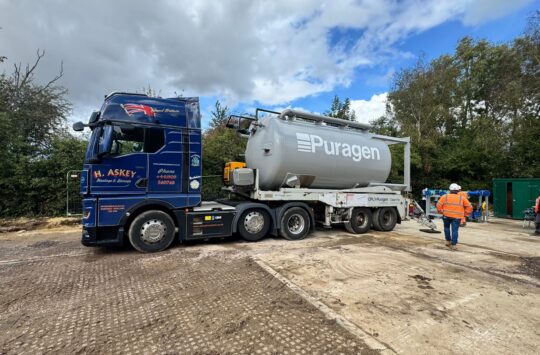
Puragen supplied two AquaSorber® 22-100 mobile filtration units, each loaded with high-performance granular activated carbon (GAC), specifically selected to meet the treatment requirements of the site.
The mobile units were delivered on dedicated trailers and positioned directly at the designated treatment location. Supplied pre-filled with activated carbon and commissioned immediately upon arrival, the system eliminated the need for on-site carbon handling and significantly minimized operational disruption.
Carbon Selection:
- Specialized GAC with an optimized pore structure for PFAS adsorption
- Effective for both long- and short-chain PFAS compounds
- A sustainable solution utilizing both virgin and high-quality reactivated carbon
Results
Post-treatment analysis demonstrated that all eight PFAS species were reduced to below detectable limits, including the successful removal of PFHxA. Performance remained stable despite high contaminant loading.
The data confirmed that the selected GAC delivered exceptional adsorption performance for both long- and short-chain PFAS compounds.
Following reactivation of the spent carbon, testing confirmed:
- Effective destruction of PFAS from the spent carbon
- Restored adsorption performance of the reactivated GAC
- Sustainable lifecycle management compared to single-use carbon solutions