
Background
A food and agricultural waste biomethane production site in the UK was facing recurring challenges with gas quality compliance due to limitations in its fixed activated carbon filtration system. The site had previously installed a single VOCSorber® 30 mobile filter to support purification before gas-to-grid injection, but persistent flow restrictions remained a concern. The existing setup required frequent carbon replacement and did not provide sufficient resilience to maintain output during peak demand or breakthrough events.
Challenge
Due to strict gas quality tolerances, the site was often required to reduce biomethane flow to the grid whenever the activated carbon became saturated and could no longer meet treatment targets. A single VOCSorber® 30 unit had been installed to address these limitations, replacing less efficient fixed filters. However, site operators were hesitant to implement a second unit due to space constraints and installation complexity. Without additional capacity, the plant was at risk of unplanned downtime and reduced performance.
Solution
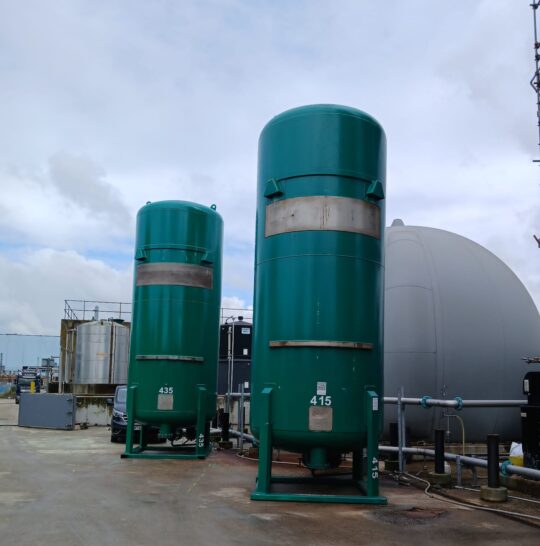
Puragen’s engineering team conducted a detailed site visit to assess whether a second VOCSorber® 30 filter could be installed within the limited available footprint. A custom design was proposed, incorporating a lead/lag filtration system where the first filter performs bulk contaminant removal and the second “polishes” the gas stream to ensure compliance.
Despite the complexity of the site, Puragen completed the design, manufacturing, and pipework installation within just two weeks, aligning the work with the site’s planned annual shutdown to eliminate additional downtime. The retrofit included bespoke pipe routing and skid placement to optimise performance and space usage.
Key Factors for Success
- Engineering Agility: Rapid response and on-site customisation made implementation possible in a tight timeframe.
- Lead/Lag Configuration: Provided increased treatment resilience and reduced the risk of breakthrough.
- Footprint Optimisation: Careful design allowed installation despite initial concerns around space.
- Downtime Avoidance: Completion during scheduled shutdown avoided production interruptions.
Outcome / Results
The site is now running at full load, with improved biomethane output and plant uptime. The dual-filter setup provides enhanced purification performance and greater operational flexibility, reducing the frequency of changeouts and ensuring reliable grid compliance.