
Context
PFAS contamination on a site in France, highlights the increasing regulatory and operational challenges facing water utilities across Europe. From 2023, routine analyses identified PFAS in drinking water sources, with concentrations exceeding the regulatory limit of 0.1 µg/L and reaching levels of 0.4-0.6 µg/L. By April 2025, consumption restrictions were introduced for sensitive populations, including pregnant women and infants.
The contamination was primarily linked to the historical use of firefighting foams at a nearby airport Airport, impacting around 11 municipalities and up to 60,000 residents. The most contaminated sources were shut down, and dilution strategies alone proved insufficient to restore compliance.
Challenge
The situation presented a substantial challenge, with PFAS concentrations exceeding regulatory limits and an urgent need to restore safe drinking water to affected communities. As dilution strategies proved ineffective, a rapid and scalable treatment solution was required. It was imperative that the handling and disposal of PFAS-contaminated spent carbon be carefully managed to mitigate the risk of secondary environmental impacts.
Solution
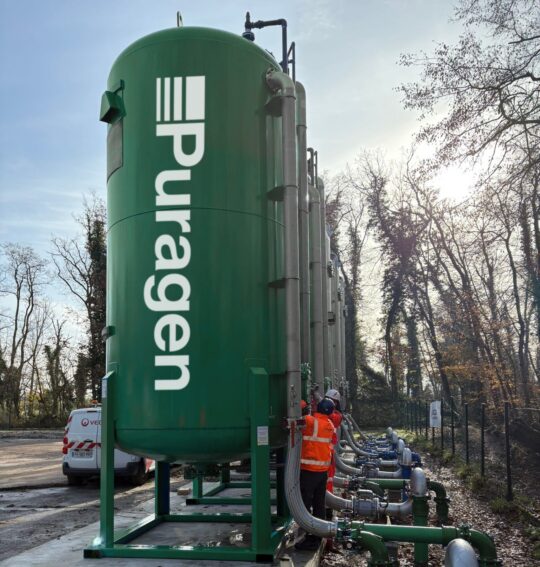
As part of an emergency response, CleanFlo® mobile filtration systems were deployed to treat contaminated water sources. The installation included six filters, incorporating three AquaSorber® 22-100 mobile filter units prefilled with Puragen FiltraPure® granular activated carbon (GAC), specifically engineered for effective PFAS removal.
Puragen supported the project through the supply of high-performance re-agglomerated GAC and a fully integrated lifecycle approach, including carbon replacement, logistics, handling and the responsible destruction of PFAS-contaminated spent carbon. Puragen’s Search, Capture, Destroy approach ensures that PFAS are not only removed from the water, but are fully destroyed during the reactivation process of spent carbon, eliminating the risk of re-release.
Key factor for success
- Rapid deployment of mobile filtration systems
- High-performance activated carbon tailored for PFAS removal
- Continuous performance monitoring and scheduled carbon replacement
- Integrated carbon lifecycle management (handling, transport, destruction)
- Scalable solution adaptable to multiple affected sites
Results
Following implementation, PFAS concentrations were successfully reduced below regulatory limits, this allowed drinking water restrictions to be lifted at the end of 2025. A reliable and continuous supply of safe drinking water was restored for the affected communities. Sustained treatment performance is ensured through regular carbon replacement, with new filters delivered every four months.
This approach also supports reduced environmental impact by combining effective PFAS removal with responsible destruction and carbon reactivation, minimising reliance on landfill or incineration and lowering overall lifecycle emissions.