
Background
A leading biogas operator was preparing to open a new large-scale anaerobic digestion (AD) facility, expanding its capacity to convert organic waste into renewable energy and valuable resources. Committed to advancing the circular economy, the company transforms organic residual streams into biogas, green gas, organic fertilisers and bio-CO₂, helping reduce waste and support a more sustainable, low-carbon future.
Taking a fully integrated approach, the company develops, constructs and operates its facilities entirely in-house, maintaining control over every stage of the process, from initial development through to ongoing operations.
Operating across two sites, the new facility processes a variety of organic feedstocks, including food waste and plant-derived materials. To support the new sites, a reliable and effective biogas purification solution was required to remove contaminants, protect downstream equipment and ensure consistent gas quality across its operations.
Challenge
Biogas generated through anaerobic digestion contains a mixture of gases, including methane and carbon dioxide, alongside impurities such as hydrogen sulfide (H₂S) and volatile organic compounds (VOCs).
These contaminants present several operational challenges:
- Hydrogen sulfide: A toxic and corrosive gas that can damage equipment, contribute to maintenance requirements and compromise downstream gas processing.
- Volatile organic compounds: Depending on their composition and concentration, VOCs can affect gas quality, equipment performance and the suitability of the biogas for its intended end use.
- Variable gas composition: Changes in organic feedstock and digestion conditions can lead to fluctuations in contaminant concentrations, requiring a robust and adaptable treatment solution.
- Efficient and economical gas purification: essential to achieving the required biogas quality, while minimising operating costs and maximising the value of renewable energy production.
With two operational sites, the company required a reliable filtration solution capable of managing contaminant loading while providing operational flexibility and continuity of treatment.
Solution
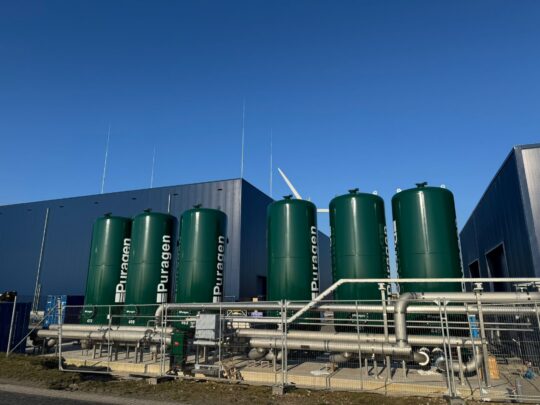
A activated carbon filtration system was incorporated into the biogas purification process at each site, providing targeted removal of hydrogen sulfide and VOCs.
Each facility is equipped with six activated carbon filters, comprising:
– Three filters dedicated to VOC removal, using activated carbon selected for the target organic contaminants.
– Three filters dedicated to hydrogen sulfide removal, using specialist activated carbon media selected for effective H₂S treatment.
The filtration systems operate in a lead-lag configuration, where gas passes through a primary treatment filter followed by a secondary polishing filter. This arrangement supports consistent contaminant removal while providing additional protection against breakthrough.
As the lead filter approaches its treatment capacity, the second provides a further stage of purification, helping maintain the required gas quality. With appropriate monitoring and changeover procedures, this configuration also supports efficient media utilisation and planned maintenance.
Activated carbon media is selected according to the specific contaminants, operating conditions and treatment requirements, ensuring that the VOC and H2S removal stages are appropriately matched to their respective duties.
Results
Results
The installation of dedicated activated carbon filtration systems across both facilities provided a robust and reliable approach to biogas purification, supporting the operator’s renewable energy production and circular economy objectives.
- Effective contaminant removal: Dedicated activated carbon filtration stages target hydrogen sulphide (H₂S) and volatile organic compounds (VOCs), helping maintain the required biogas quality.
- Protection of downstream equipment: Reducing corrosive and potentially harmful contaminants helps minimise equipment damage, maintenance requirements and operational disruption.
- Improved operational reliability: The lead-lag configuration provides an additional stage of treatment, helping protect against contaminant breakthrough and maintain consistent gas quality.
- Optimised carbon service life: The lead-lag arrangement allows for more effective utilisation of the activated carbon media, supporting planned maintenance and efficient carbon replacement.
- Supporting sustainable energy production: Reliable biogas purification contributes to the conversion of organic waste into renewable energy and valuable resources, reinforcing the company’s commitment to the circular economy.